
Understanding Obsessive-Compulsive and Related Disorders: Signs and Science
In casual conversation, people often throw around terms like OCD to describe a fondness for neatness, organized desks, or a meticulous cleaning habit. However, this casual usage deeply misrepresents the true nature of Obsessive-Compulsive and Related Disorders.
In the medical and psychological fields, this category represents a distinct spectrum of mental health conditions characterized by intense psychological distress, rigid behavioral patterns, and significant disruptions to daily functioning.
Understanding the unique aspects of these conditions is vital to recognizing their impact and fostering genuine mental health awareness.
Defining the Core Architecture of the Spectrum
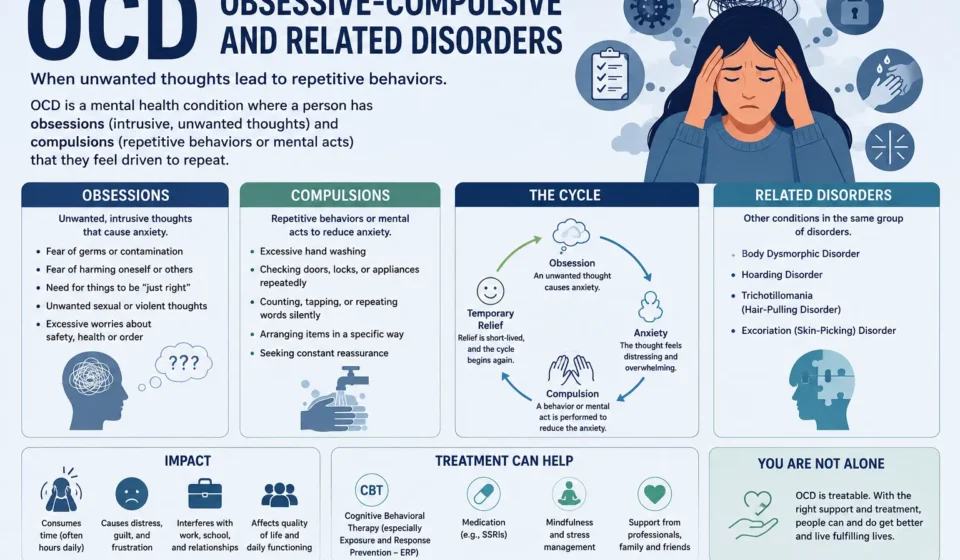
This diagnostic category encompasses a group of conditions that share closely linked clinical features. The defining hallmark is the presence of intrusive, persistent thoughts or uncontrollable, repetitive behaviors that an individual feels driven to perform.
While Obsessive-Compulsive Disorder is the anchor condition, the broader clinical spectrum officially includes:
-
Body Dysmorphic Disorder: A distressing preoccupation with perceived flaws or defects in physical appearance that are unnoticeable or minor to others.
-
Hoarding Disorder: A persistent difficulty discarding or parting with possessions, regardless of their actual value, leading to severe clutter that compromises living spaces.
-
Trichotillomania and Excoriation: Repetitive, body-focused behaviors centered around hair-pulling or skin-picking, often driven by anxiety or sensory urges.
Separating Obsessions from Compulsions
To understand the day-to-day experience of someone living with these disorders, it is crucial to analyze the two-part cycle that drives most of these conditions: obsessions and compulsions.
Obsessions are recurrent, persistent, and intrusive thoughts, urges, or mental images. These are not pleasant daydreaming; they cause severe anxiety or distress. Common themes include fears of contamination, a demand for absolute symmetry, or forbidden, distressing thoughts.
Compulsions are repetitive behaviors or mental acts that an individual feels driven to perform in response to an obsession. These can include excessive handwashing, ordering objects in a specific sequence, checking locks repeatedly, or silent mental counting. Crucially, these actions are performed to reduce anxiety or prevent a feared event, but they offer only temporary relief and are clearly excessive.
The Neurological and Genetic Underpinnings
These disorders are not a choice, nor do they stem from a simple personality flaw. Brain imaging studies and genetic research point toward clear biological foundations.
Neurological data shows that these conditions are heavily tied to structural and functional abnormalities in specific brain pathways, particularly the frontostriatal circuits, which connect the frontal lobes to the basal ganglia. These circuits help manage behavioral execution and habit formation.
When this pathway experiences communication glitches—often involving neurotransmitters like serotonin and dopamine—the brain struggles to switch off the “error signal.” This leaves the individual feeling like something is perpetually wrong until the compulsion is fulfilled.
The Vicious Cycle of Avoidance and Temporary Relief
Living with these conditions involves navigating an exhausting emotional loop. The behavioral pattern typically follows a predictable sequence that reinforces itself over time.
Recognizing the Path to Long-Term Management
Because these disorders are deeply rooted in behavioral loops and brain chemistry, willpower alone is rarely enough to break the cycle. Professional psychological care is the gold standard for long-term relief.
Evidence-based approaches heavily rely on a specialized form of Cognitive Behavioral Therapy known as Exposure and Response Prevention. Under this framework, individuals are safely exposed to the thoughts or triggers that spark their anxiety but are guided to resist performing the accompanying compulsion. Over time, the brain learns that the anxiety dissipates naturally without the ritual. Gradually weakening the entire disorder’s hold on their daily life.
Key Takeaway: Obsessive-Compulsive and Related Disorders are exhausting medical conditions, not quirky personality traits. Recognizing the difference between ordinary neatness and the distressing cycle of clinical obsessions is the first step toward true empathy and effective support.
Sponsored Link: https://www.ez96live.com/